← Back
Behavioral Obfuscation

SentriPup
GhostNode™

Live -- Running Now

PerimeterGuard blocks the surveillance traffic. GhostNode does something more devious -- it poisons it. While your real behavior stays hidden, GhostNode floods the surveillance economy with convincing fake behavioral data. Realistic browsing patterns. Decoy DNS traffic. Dozens of phantom versions of you, all doing different things, all at once.

The data brokers collect every bit of it. They pay for it. They analyze it. And what they get back is completely worthless. They don't even know they lost. That's the part that makes me smile.

GhostNode Control Panel -- Phantom Mode Active
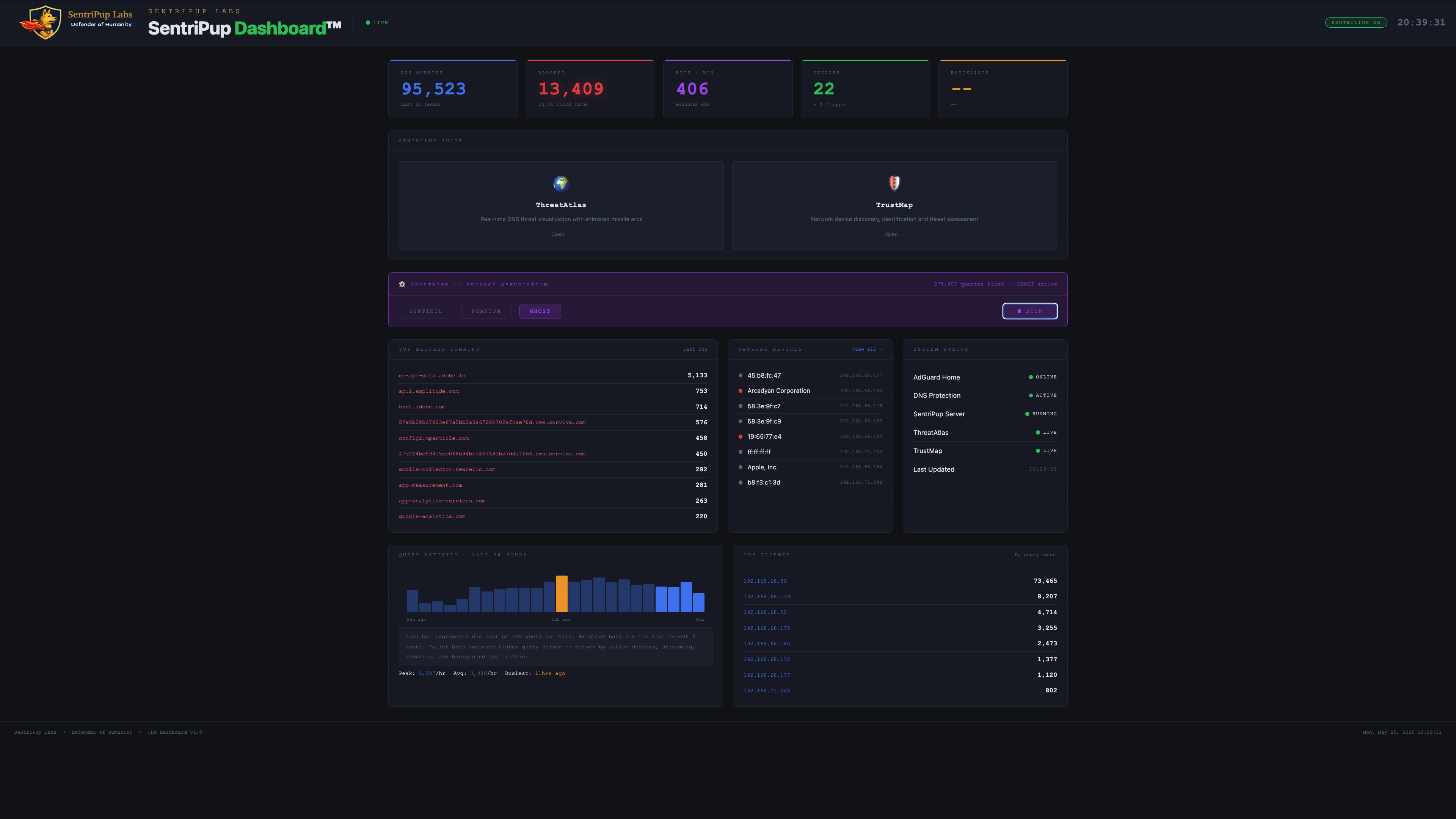
SentriPup Dashboard showing GhostNode in Phantom mode with 270,647 queries fired
270,647 decoy queries fired -- and counting
The Strategy

Don't just block them. Confuse them.

Blocking is defense. GhostNode is offense. When you can't pass a law to protect your privacy, you make your data so unreliable that collecting it becomes pointless.

The Problem with Blocking Alone
Silence is still a signal
When PerimeterGuard blocks a surveillance request, the data broker notices -- a gap in the behavioral record. Enough gaps and they know someone is running a blocker. They adjust. They find other ways. Blocking is necessary but it's not invisible.
The GhostNode Solution
Noise is better than silence
GhostNode fills those gaps -- and then some. Instead of a silent void where your behavioral data should be, the surveillance economy receives a flood of convincing activity. Your household appears to be dozens of different entities. No two profiles match. The dossier they're building on you is fiction -- and they're paying to build it.
Operating Modes

Three levels of confusion.

GhostNode runs in three modes -- you choose how aggressive to get. The purple arcs you see on ThreatAtlas are GhostNode working. All three modes run exclusively on bandwidth already reclaimed from blocked surveillance traffic. It was leaving your network anyway. Now it works for you.

Sentinel
Low Noise
The baseline operating mode. GhostNode begins generating behavioral noise -- fragmenting any profile being built on your household and giving the surveillance economy its first taste of fiction.
Phantom
Active
GhostNode begins generating realistic behavioral noise -- DNS queries timed to mimic natural browsing patterns, randomized traffic signatures, decoy activity that blends seamlessly with the real traffic on your network.
Ghost
Maximum
Full obfuscation. GhostNode floods the surveillance economy with high-volume behavioral decoys. The purple arcs on ThreatAtlas show you exactly where the confusion traffic is going -- Europe, Africa, Asia, everywhere. Your real signal is buried.
What It Does

Offense, defense, and confusion.

GhostNode doesn't replace PerimeterGuard -- it works alongside it. While PerimeterGuard kills the inbound probes, GhostNode poisons the outbound data stream.

👻
Behavioral Decoy Generation
Generates realistic DNS traffic patterns that mimic natural human browsing behavior -- timed, varied, and convincing enough to fool behavioral analysis algorithms.
🌍
Global Noise Distribution
Decoy traffic is distributed across multiple destinations worldwide -- creating the appearance of a household with dozens of simultaneous users across different behavioral profiles.
🗺️
ThreatAtlas Visualization
Every GhostNode outbound decoy appears as a purple arc on the ThreatAtlas global map -- so you can watch your confusion campaign in real time. The arcs don't lie. The brokers will.
⚙️
Three Operating Modes
Sentinel for passive learning, Phantom for active obfuscation, Ghost for maximum confusion. You control the intensity. The Dashboard puts it one click away.
🎭
Profile Fragmentation
By generating multiple conflicting behavioral signatures simultaneously, GhostNode fragments any profile being built on your household into dozens of inconsistent, unusable shards.
🛡️
Works Alongside PerimeterGuard
GhostNode and PerimeterGuard are designed to run together. One kills the probes. The other poisons the data stream. Together they're the most complete behavioral privacy defense available to a home network.
How It Works

The economics of useless data.

The Surveillance Business Model
They pay for behavioral data by volume
Data brokers buy behavioral profiles in bulk -- paying per record, per data point, per verified behavioral signal. The entire surveillance economy is built on the assumption that the data they're collecting is accurate. That assumption is GhostNode's attack surface.
The GhostNode Attack
Make the data expensive and worthless
When GhostNode is running, the surveillance economy receives real-looking data that costs them real money to collect, store, and analyze -- and returns zero usable signal. They can't tell which data points are real. They can't build a reliable profile. The cost goes up. The value goes to zero.
What They See
A household that makes no sense
From the outside, your network looks like it contains dozens of simultaneous users with wildly different behavioral patterns -- different browsing habits, different timing, different geographic signatures. No machine learning model can reconcile the data into a coherent profile. It's noise all the way down.
The Purple Arcs
What you see on ThreatAtlas
Every purple arc on the ThreatAtlas map is a GhostNode decoy leaving your network -- heading to a surveillance endpoint somewhere in the world. Africa. Europe. Asia. Each one is a piece of fiction the surveillance economy is about to pay for. Watch it work. That's your data. Your rules. Your terms.
The data brokers still collect it. They pay for it. They analyze it. And what they get back is completely worthless.
They don't know they lost. That's the part that makes me smile. -- Ray Brown, Retired CISO, Founder of SentriPup Labs
See It Live

This is what confusion looks like.

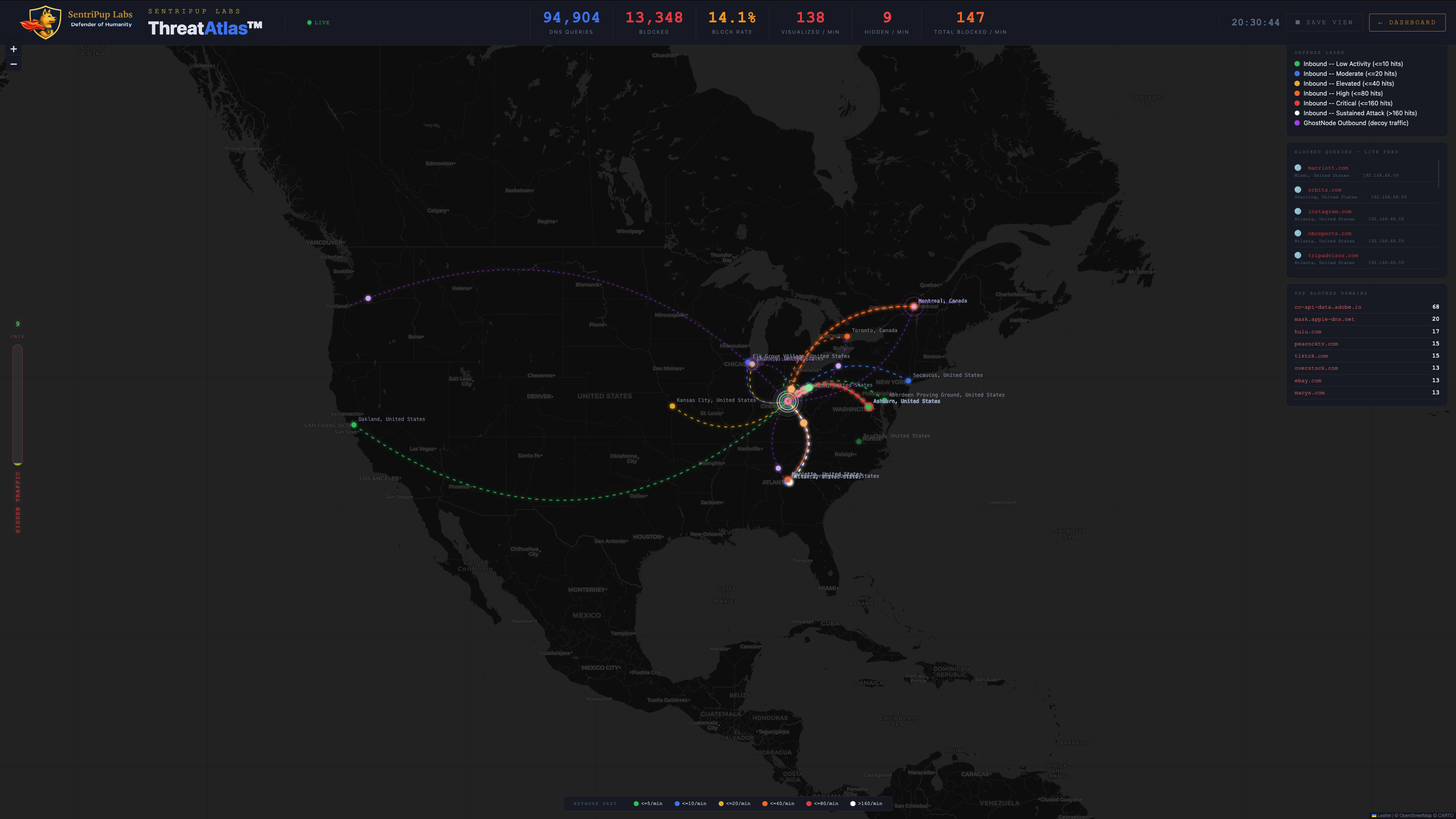
ThreatAtlas running in Ghost mode, live from the SentriPup Labs facility in Butler County, Ohio -- that dot on the map is us. One person. One phone. One news app. At peak, that single activity was generating over 200 surveillance probes per minute -- all of them stopped. Now watch what happens when GhostNode activates. Color-coded arcs show inbound surveillance probes being killed by PerimeterGuard -- green through red based on hit frequency. Purple arcs are GhostNode outbound decoys -- fake behavioral data flooding the surveillance economy in real time. The trackers think they're collecting. What they're actually getting is fiction -- worthless noise that poisons their data and wastes their money.

Color-Coded Inbound Arcs -- Defense
Inbound surveillance probes intercepted and killed by SentriPup PerimeterGuard. The arc color reflects frequency -- green is low activity, yellow and orange are moderate, red is heavy. The hotter the color, the harder your network is being hit at that moment.
Purple Arcs -- Offense
GhostNode outbound decoys -- realistic behavioral noise sent to surveillance endpoints worldwide. The data brokers collect it, pay for it, and get back something completely worthless. They don't even know they lost.
Act 2 -- The Effect on ThreatAtlas
ThreatAtlas live map showing GhostNode purple decoy arcs looping across the United States -- ghost: homepoint.com and ghost: threadplus.com visible
Purple arcs = GhostNode outbound decoys. The ghost: labels show exactly where your fiction is going.

If the Surveillance Economy is a myth -- why the 200 tracking probes per minute on one person reading one news article? That infrastructure costs billions to build and billions to run. Which means they're making even more billions selling what they take from you. The math doesn't lie. Your privacy is worth a fortune -- to everyone except you.

Ready to become ungovernable?

SentriPup GhostNode is part of the HPS™ Alpha suite. Join the early access list and be among the first to unleash it on the surveillance economy.

Next in the HPS™ Alpha Suite
SentriPup Dashboard™
Your command center -- all five tools, one view, always running.
See the Dashboard™ →